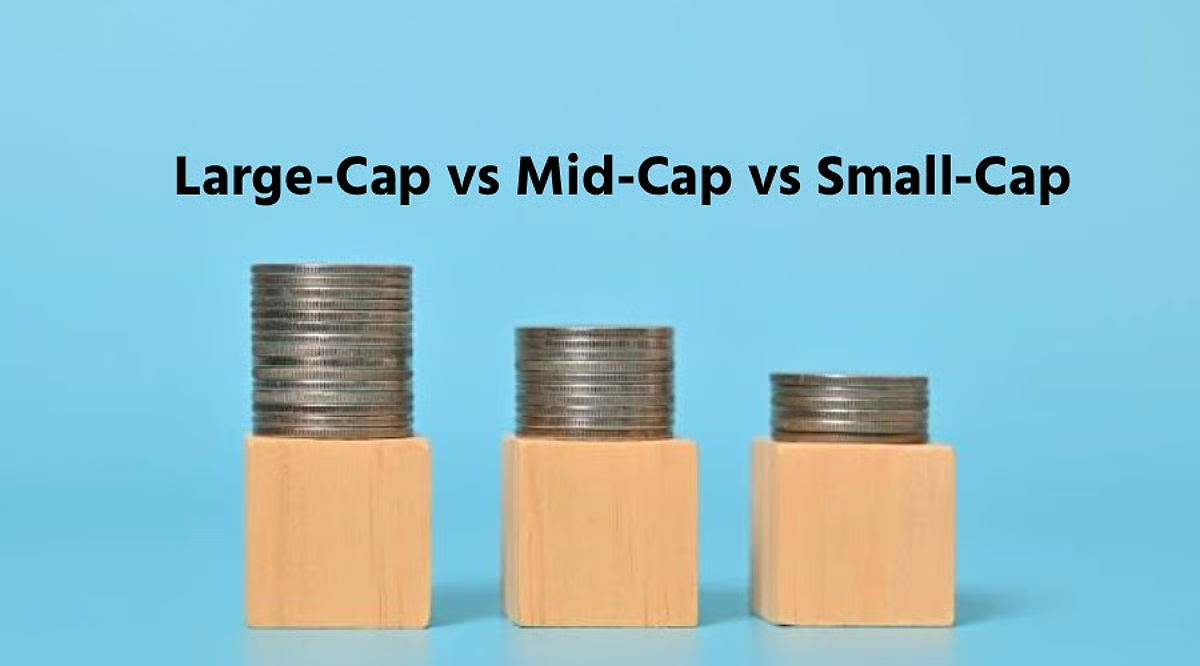
The stock market contains companies of vastly different sizes. A global technology company can be worth trillions of dollars, while a smaller company may be valued at only a few hundred million.
One common way investors organize these companies is by market capitalization, or market cap. This creates categories such as large-cap, mid-cap, and small-cap stocks.
These categories can help investors understand the general characteristics and risks associated with different parts of the stock market. However, they are not guarantees of performance or safety.
What Does “Cap” Mean?
The word “cap” refers to market capitalization.
Market capitalization is calculated by multiplying a company’s share price by the number of its outstanding shares.
For example, if a company has 200 million shares trading at $25 each, its market capitalization is $5 billion.
Companies are then grouped into different size categories based on their market capitalization.
There is no single universal set of boundaries used by every financial institution. The definitions can vary by index provider, fund manager, or market. However, the general concept remains the same: large-cap companies are larger than mid-cap companies, which are larger than small-cap companies.
What Are Large-Cap Stocks?
Large-cap stocks represent companies with relatively large market values.
These businesses are often well established, have significant revenues, and may operate across multiple countries or industries.
Large companies can have advantages such as established brands, large customer bases, access to capital, and extensive infrastructure.
Some large-cap businesses also pay regular dividends, although not all do.
Because these companies are often closely followed by professional investors and financial analysts, there can be substantial information available about their financial performance.
However, being large does not mean a company is immune to problems. Large companies can still lose market share, experience declining profits, face regulatory challenges, or become disrupted by new technology.
What Are Mid-Cap Stocks?
Mid-cap stocks fall between large-cap and small-cap companies.
Many mid-cap businesses have already established themselves within their industries but may still have considerable opportunities for expansion.
They might be expanding internationally, developing new products, opening additional locations, or increasing their market share.
This combination can make mid-cap stocks interesting to investors looking for companies that are more established than many small businesses but may still have substantial growth opportunities.
At the same time, mid-cap companies may not have the same financial resources or competitive advantages as the largest corporations.
Their stock prices can therefore be more sensitive to economic conditions and company-specific developments.
What Are Small-Cap Stocks?
Small-cap stocks represent relatively smaller publicly traded companies.
Some are mature businesses operating in specialized industries, while others are younger companies attempting to expand rapidly.
Small companies can have significant growth potential because even a relatively small increase in market share can have a meaningful effect on their revenue.
However, their smaller size can also create additional risks.
A small company may have fewer financial resources, less diversified revenue, greater dependence on a small number of customers, or more difficulty obtaining financing during difficult economic conditions.
Small-cap stocks can therefore experience substantial price volatility.
Why Company Size Matters
Company size can influence how a business responds to economic conditions.
Large companies often have more resources to withstand temporary downturns. They may have multiple products, geographic markets, and sources of revenue.
Smaller companies may have fewer buffers. A major customer loss, rising borrowing costs, or a sudden decline in demand can have a larger effect on their financial performance.
However, larger companies can also become difficult to grow at very high rates simply because their existing businesses are already enormous.
This creates an important trade-off between scale and growth potential.
Growth Potential Across Market-Cap Categories
Smaller companies are sometimes associated with higher growth potential, but this should not be interpreted as a guarantee.
Imagine a company worth $500 million that eventually grows into a $5 billion business. That represents a tenfold increase in market value.
For a company already worth $500 billion, achieving the same percentage increase would require creating hundreds of billions of dollars in additional value.
This is one reason investors sometimes look toward smaller companies for potential growth.
However, many small businesses fail to achieve their expected growth. Some remain stagnant, become financially distressed, or disappear entirely.
Higher potential growth therefore comes with higher uncertainty.
Risk and Volatility
Market-cap categories can also differ in their typical levels of volatility.
Small-cap stocks often experience larger price movements than large-cap stocks because they can have lower trading volumes and greater sensitivity to company-specific news.
Mid-cap stocks may fall somewhere between the two.
Large-cap stocks can still experience major declines, especially during severe market downturns, but their size and established operations can provide certain advantages.
These are general tendencies rather than fixed rules. Individual companies can behave very differently from the broader category they belong to.
How Investors Use Market-Cap Categories
Investors can use market-cap categories when constructing diversified portfolios.
For example, someone might hold large-cap stocks for exposure to established companies while also including mid-cap and small-cap stocks for broader market exposure.
Investment funds and exchange-traded funds are often designed around these categories, allowing investors to gain exposure to groups of companies rather than selecting individual stocks.
This can also reduce the impact of one company’s poor performance on the overall investment.
Market-Cap Categories Can Change
A company does not permanently belong to one market-cap category.
If its stock price rises significantly, its market capitalization can increase enough to move it from one category to another.
The opposite can happen after a prolonged decline in its share price.
Corporate actions such as issuing new shares or buying back existing shares can also affect market capitalization.
As a result, market-cap classifications are best viewed as descriptions of a company’s current size rather than permanent labels.
Large, Mid, and Small Does Not Mean Good, Better, or Worse
It is important not to interpret market capitalization as a ranking of investment quality.
A large-cap stock is not automatically safer than every small-cap stock, and a small-cap stock is not automatically more profitable.
A company’s valuation, financial health, competitive position, management, industry, and future prospects all matter.
Market capitalization simply provides context about the scale of the business.
Why Market-Cap Segments Matter to Financial Markets
Large-cap, mid-cap, and small-cap companies collectively represent different parts of the economy and stock market.
Large companies can dominate major indexes, while smaller companies can provide exposure to businesses that may be earlier in their growth cycles.
Changes in economic conditions can affect these groups differently. For example, rising borrowing costs may place greater pressure on smaller companies that rely heavily on external financing.
Understanding these differences helps investors interpret market performance beyond simply asking whether “the stock market” went up or down.
The Key Takeaway
Large-cap, mid-cap, and small-cap stocks are categories based primarily on a company’s market capitalization.
Large-cap companies are generally more established and financially substantial.
Mid-cap companies occupy the middle ground, often combining established operations with further growth opportunities.
Small-cap companies are generally smaller and may offer greater growth potential, but they can also carry greater volatility and financial risk.
None of these categories is inherently better than the others. They simply represent different segments of the stock market, each with its own characteristics and potential risks.
Leave a Reply